
Please note that this website will no longer be updated regularly. If you have any queries, concerns or comments about the site and its content please send me a message through the Contact Me section.
Category: Uncategorized
Glengarnock Gleanings (June 1920) | Colvilles Staff Magazine


Original June 1920 issue of Colville’s Magazine featuring the Glengarnock Gleanings section. Includes a portrait and profile of John Kane, O.B.E., reports on Works and community sport, the Guide Mill picnic to Rothesay, and the Second Annual Works Sports Meeting. Fully transcribed and preserved below – original scans are above (pp. 103–105).
The issue also features the humorous illustration “Betty—and ‘Oor John.’”, drawn by Geo. Kirkwood, together with a humorous column titled “Swatches o’ Wut.” by the Kilbirnie Philosopher.
- Mr. John Kane – long-serving employee at Glengarnock Works, featured with portrait and an account of the courage for which he received the Medal of the Order of the British Empire
- Mr. Robert Craig, Jun. – Office Staff member congratulated for his achievements in the “Colville” Golf Cup Competition
- Illustration: “Betty—and ‘Oor John.’” – humorous cartoon drawn by Geo. Kirkwood
Glengarnock Gleanings (May 1920) | Colvilles Staff Magazine


Original May 1920 issue of Colville’s Magazine featuring the Glengarnock Gleanings section. Includes a profile and portrait of Mr. William Blue, a long-serving Blast Furnace worker with over fifty years’ service, along with reports on social events, football activity, Works organisations, and community life. Fully transcribed and preserved below – original scans are above (pp. 84–86).
Continue reading “Glengarnock Gleanings (May 1920) | Colvilles Staff Magazine”Glengarnock Gleanings (May – various 1920) | Colvilles Staff Magazine


Below is a transcription of the material visible in the above scans regarding Glengarnock.
Continue reading “Glengarnock Gleanings (May – various 1920) | Colvilles Staff Magazine”Glengarnock Gleanings (April 1920) | Colvilles Staff Magazine


Original April 1920 issue of Colville’s Magazine featuring the Glengarnock Gleanings section. Includes a profile and portrait of Hugh Munro, a portrait of juvenile champion Andrew McDowal, along with local social events, football activity, community gatherings, and reports from the Works. Fully transcribed and preserved below – original scans are above (pp. 67–68).
The issue also features a humorous illustrated piece titled “Useless!”, drawn by Jas. Holmes of Glengarnock, reflecting everyday workplace life and humour of the period.
- Mr. Hugh Munro – long-serving employee at Glengarnock Works, featured with portrait and profile
- Mr. Andrew McDowal – Juvenile Champion, Scottish Inter-Works Sports (1919), shown in portrait
- Illustration: “Useless!” – humorous drawing depicting two men in a washroom setting drawn by Jas. Holmes, Glengarnock
Glengarnock Gleanings (January 1920) | Colvilles Staff Magazine

Original January 1920 issue of Colville’s Magazine Glengarnock Gleanings section. Includes local news, football results, YMCA activities, and a historical report of a tragic accident. Fully transcribed and preserved below – original scan is above:
Continue reading “Glengarnock Gleanings (January 1920) | Colvilles Staff Magazine”Esther Brisco and Neil McTaggart
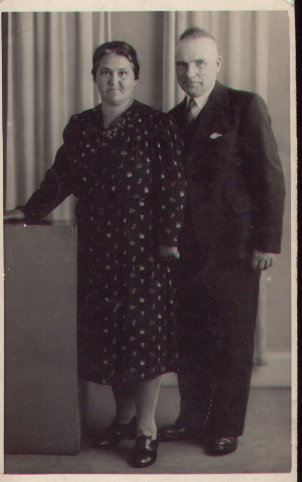
Neil and Esther McTaggart – taken at Jerome’s Photography studio Glasgow 1938 to give to the kids before they went to war. They lived at the Longbar and before that Schoolwynd, Kilbirnie.
New Radio Archive about Local Heritage
I have started a new audio archive with many of my recordings about local history, South West Scotland and other things I have made over the years. You can hear it by clicking on the menu at the side of the site – I’m still testing it and adding new content. I am aware that right now everything is lumped together.
As I add more content, it will sort itself out.
On mobile devices, it is appearing at the bottom of the page.
Joseph.
New Audio Book – St Brigids Catholic Church Kilbirnie
You can access it here:
Audio Book about the Knox family
I have added an audio version to my book about the Knox Family of KIlbirnie.
You can hear it on the page, here.