Kilbirnie’s Museum (The Stables)

During the 1980s and a bit of the 1990s there was a museum under the Walker Hall – it was accessed via a small alleyway right next to the hall and the sign “museum” hung on it long after the museum disappeared. It was called the Stables museum because supposedly before the Walker Hall, there were stables there and also the remains of a very old medieval pub.

I have been in touch with the council to try and find out where the stuff went when it closed. They have given me a catalogue of stuff they hold from the museum which you can access here.

There are a few things missing though which I can clearly remember which you can see below:

  1. A 19th century original portrait picture of Robert William Knox of Moorpark in a frame
  2.  The block cement stone from the lamp on the bridge which was Robert William’s gift to the town.  It has engravings on there. 

It is possible that the picture was loaned either from the Knox Institute which was at the cross in Kilbirnie (it’s been closed for years though), the Masonic Lodge, the mill office or the main Walker Hall which the museum sat under. That would have been returned to wherever it came from when the museum closed.

 The stone from the bridge on the other hand was fairly big and my guess is that it might be stored somewhere by the council or else left under the Walker Hall where the museum was.  The lamp had long gone, it was only the stone that was left.

If anybody knows where these things are, please let me know because they should be catalogued somewhere to make sure they don’t get lost again so they hopefully can be preserved.  

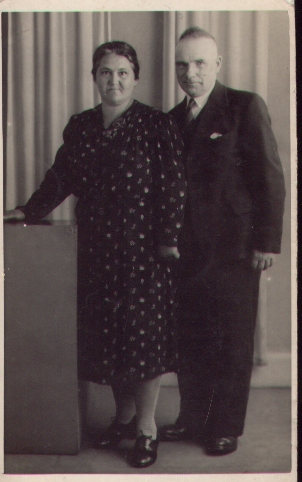
William John Glass

This is William John Glass, he was my Great Grandfather. He married Sarah Hay in 1905 and lived in Glengarnock. At the time of marriage he was living at Auchengree,  He had many brothers and sisters and came from a huge family. His parents had emigrated from Northern Ireland in the 1800’s, they were James Glass and Anne Moore from around Bushmills somehwere.

He died in Central Avenue, before it was rebuilt into private houses we know today.  They are buried in KIlbirnie old cemetery in an unmarked grave.


Beith Auld Kirk pictures

These pictures of the inside and outside of Beith Auld Kirk are very striking.  The first line of pictures show a monument

One version of the story tells me that  this is  a monument which was installed up at Spiers School. After that was demolished in the 70s the monument was removed and placed behind the Kirk in 1985…. in the Kirk yard where you can still see them today. Another person told me these were actually from Gielsland House and are called “the Gielsand marbles”.

If you know the history of these, please let me know.


Co-op and School at the Den (Barkip)

The Den was a hamlet on the main road between Beith and Dalry  – it had it’s own school, bank and shops, Episcopal church etc and was demolished in the 1900s.  You can see the pictures above of the Co-op and School which was known as Kersland Barony.

The Den (Barkip) was largely replaced with the Lambert which became known as the Lambar, then langbar and subsequently “corrected” to Longbar by the council. It is easy to see how that could have happened with the number of Northern Irish accents around at that time.

By the way – I’ve moved this site to a now host, corrected the broken links  and moved in existing subscribers.  If you see any problems, let me know.


ِDennyholm Street, Kilbirnie (again)

I have attached some photos. On one you can see Dennyholm street houses (left bottom – they look like chalets) and on the other a map showing that “the Dennyholm” (street) ran parallel to Newton Street but was on a level at the back and beneath the street. (next to number 836 on the map). The street itself ran all the way into the mill complex.

The other two photos show: the entrance to the mill complex and the demolished site before they built the new housing estate.

The North Ayrshire Directories of that time describes them as “a long row of houses prone to flooding.” The census of 1921 shows them as having only 2 rooms each. You can see them in this photo, to the left, bottom.

I have colourized this for a better effect.

The area has been completely replaced with the Dennyholm Wynd Housing Estate.

In the 1900s the street had shops and a school. Dennyholm Street no longer exists.